

Products · Overview

Whole process neutronics calculation, in one program

Multi-Functional Program for Neutronics Calculation, Nuclear Design and Safety Evaluation (TopMC, updated and extended version of SuperMC) is a large-scale nuclear design software, which has been developed by FDS Consortium for more than 30 years. Taking radiation transport calculation as the core, TopMC supports the whole process neutronics calculation containing depletion, radiation source term/dose/biohazard, material activation and transmutation.

It is featured with high efficiency and high fidelity multi-physics calculation, accurate modeling, visualized analysis and virtual simulation and intelligent nuclear design and safety evaluation. TopMC can be used for the design and safety evaluation of nuclear energy systems, as well as nuclear technology application fields.

TopMC has been widely used in more than 1000 well-known nuclear-related institutions in energy, healthcare, industry, in more than 90 countries. Related methodologies and technologies have won the National Natural Science Award, the European Prize for Innovation in Fusion Research, etc.
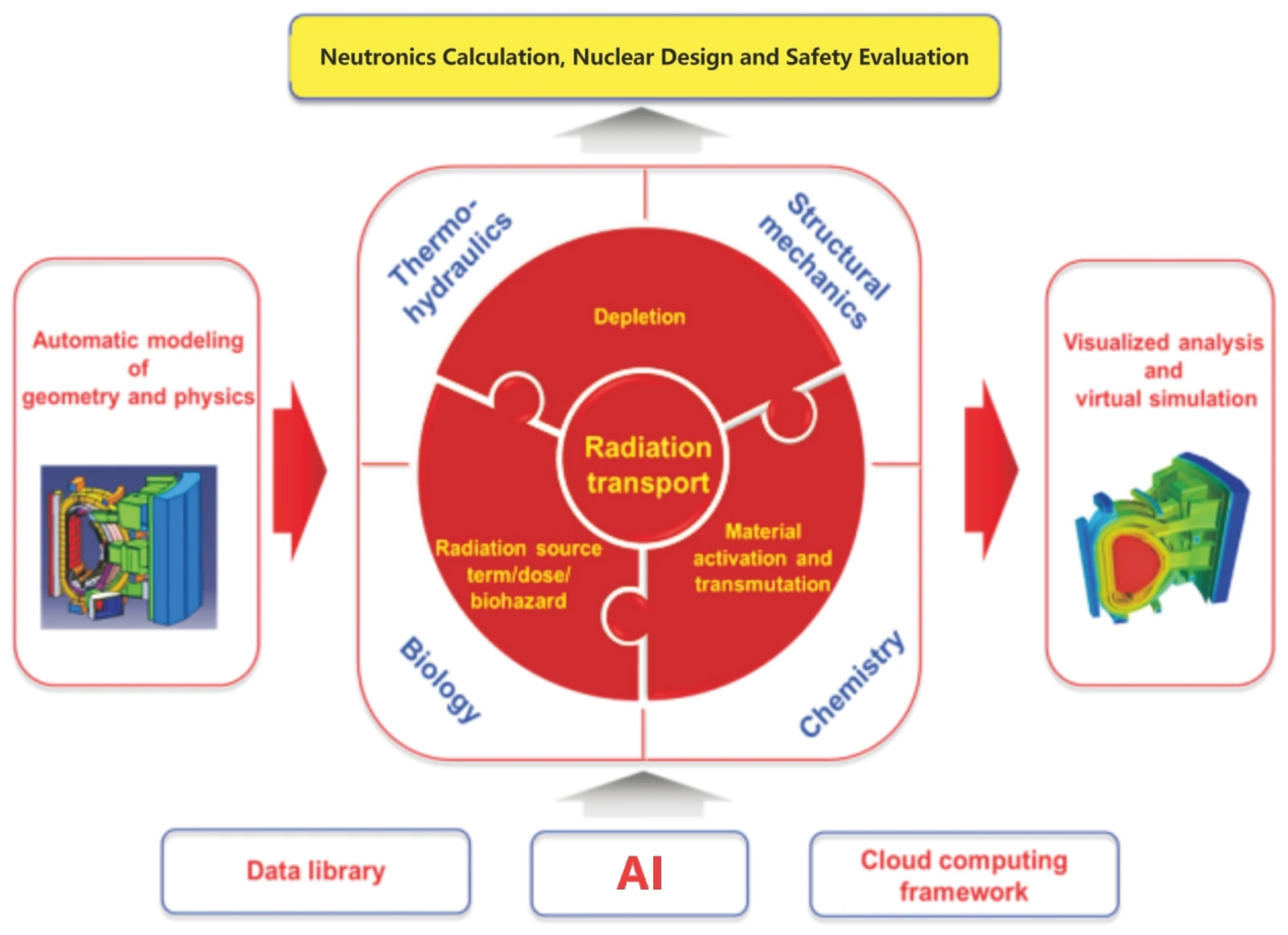
TopMC architecture: automatic modeling of geometry and physics, radiation transport core coupled with depletion, activation and source term, feeding visualized analysis and virtual simulation
TopMC architecture
  • Selected as the reference code by ITER
  • Passed the Generic Design Assessment (GDA) of the United Kingdom
  • Available from OECD/NEA and RIST/NCC
  • National Natural Science Award of China
  • European Prize for Innovation in Fusion Research

Three editions

Edition line-up and feature matrix coming soon.

Products · Functions

Eight calculation modules

From multi-particle transport to shutdown dose rate and accident evolvement — covering the full neutronics workflow of a nuclear system.

01

Radiation Transport Calculation

  • Multi-particles: neutron, photon, electron, proton, heavy ion, etc.
  • Sensitivity and uncertainty analysis, large perturbation analysis, calculation suspension and resumption, etc.
02

Isotope Depletion Calculation

  • Inner-coupling methods: beginning-of-step constant flux approximation (BOS), predictor-corrector (PC), improved semi-predictor-corrector (ISPC), etc.
03

Material Activation Calculation

  • Computational modes: point activation calculation, transport-activation inner-coupling calculation
  • Activation properties: activity, decay heat, biological hazard, dose rate, clearance index and the corresponding contribution of each nuclide in the activation properties, etc.
04

Shutdown Dose Rate Calculation

  • Rigorous-Two-Step (R2S) method
  • Improved Direct-One-Step (IDIS) method
05

Multi-physics Coupling Calculation

06

Accident Evolvement Simulation

07

Organ Dose Evaluation based on Virtual Roaming

08

Intelligent Nuclear Design and Analysis

Products · Advanced Features

What sets TopMC apart

01

Full-function & High-efficiency Neutronics Calculation

  • Inner-coupled whole process neutronics calculation
  • Strong anisotropic neutron transport
  • Multi-particle radiation dose calculation
02

CAD/Image-based Accurate Modeling for Complex Irregular Geometry

  • Parameterized high-fidelity (pin-by-pin level) whole reactor modeling
  • Whole model interactive modeling (geometry, material, source, tally, etc.)
  • Extended supporting of modeling for multiple codes, including MCNP, Geant4, FLUKA, TRIPOLI, PHITS, TORT, etc.
03

Data Analysis based on Multi-dimensional / Multi-style Visualization

  • Various styles visualization: volume rendering, visualized analysis of results coupled with geometries, etc.
  • Extended supporting of visualization for multiple codes, including MCNP, TORT, etc.
04

One-key Nuclear Design and Safety Evaluation based on Artificial Intelligence

  • Intelligent modeling: interactive generation of complex nuclear system computing models
  • Intelligent computing: intelligent prediction of key parameters of nuclear system based on deep learning
  • Intelligent analysis: nuclear analysis based on multimodal interaction